
Introduction
Historical criticism of the Bible can be a polarizing topic for evangelicals, sometimes causing a mess. This is especially true for seminary professors like Michael Licona who was forced to leave his job as a result of his use of the historical-critical method with “undesirable” conclusions. In this post, I will criticize the evangelical rejection of the historical-critical (HC) method, as I think the reasoning is problematic, inconsistent, and probably harmful to the faith (though I will not argue the last point).
This summer, I will be reading Evangelical Faith and the Challenge of Historical Criticism with some friends, and the goal of this book is to investigate what follows from the acceptance of HC to see what follows from it and to what extent it challenges, supports, or harmonizes with evangelical faith. We will see how my mind changes from reading this book, so this post can serve as a bit of a timestamp on my current thinking (though I wrote the bulk of this in 2020 as a small part of an attempt to summarize everything I believe and why, with light updating, but I don’t disagree significantly anywhere). Part of the reason I shifted my studies so much into the philosophical realm rather than biblical studies is precisely because I don’t think HC presents even an interesting challenge to the Christian faith, as the issues it most plausibly subverts are on the periphery of Christianity, not the center. I think evangelicals should not be spending much effort challenging historical criticism, but they should critically embrace its tools as a search from truth, whether it agrees with one’s presuppositions or not.
Historical-Critical Method
The historical-critical method, or historical criticism (HC), is the attempt to understand a book in its historical context and reconstruct the historical and literary environment, especially using the tools of source criticism, form criticism, and redaction criticism. I fully endorse the use of historical-critical methodology. We should use every tool in our disposal to get at truth, even if that allows for the possibility of me being wrong, including my beliefs about Scripture. While this does not obviously have implications for inerrancy (I don’t think it does), many evangelicals, including those that crafted the Chicago Statements, believe so.
So, the first article of the Chicago Statements on Biblical Inerrancy that I reject is Article XVIII: affirmation of (only) grammatico-historical exegesis and denial of “the legitimacy of any treatment of the text or quest for sources lying behind it that leads to relativizing, dehistoricizing, or discounting its teaching, or rejecting its claims to authorship.” In other words, this Article denies historical-critical methodology if it leads to a less conservative position, but it can be accepted otherwise. This is completely inconsistent and is special pleading.
Similarly, Article XVI of the Chicago Statements on Biblical Hermeneutics affirms “that legitimate critical techniques should be used in determining the canonical text and its meaning” but denies “the legitimacy of allowing any method of biblical criticism to question the truth or integrity of the writer’s expressed meaning, or of any other scriptural teaching.” This statement is perhaps even more clearly special pleading, as it affirms “legitimate” techniques but then immediately restricts “legitimate” to mean only those techniques that support their position. This isn’t even a respectable view.
There are many examples where a “quest for sources lying behind it” (source criticism) leads to 1) greater understanding and 2) evidence of historicity as opposed to ahistoricity. One of the most prominent and regarding a central event for the Christian faith is the pre-Pauline tradition behind the creed in 1 Corinthians 15. This tradition is dated even by critical scholars[1] to within 3-5 years of the crucifixion and supports the historicity of the text. Another example is the pre-Markan passion narrative,[2] again supporting the historicity of the text.
Robert Stein has a great book, The Synoptic Problem: An Introduction, that thoroughly investigates some of the issues regarding the synoptic Gospels, Matthew, Mark, and Luke, using the historical critical method. He specifically uses source, form, and redaction criticism. Source criticism looks at literary use of Mark by Matthew and Luke (among other literary dependence relationships), form criticism looks at the oral tradition behind the Gospels, and redaction criticism looks at the use of the authors to make redactions for a theological point. Stein weighs the evidence of things like the extensive verbatim quotation of Mark by Matthew to determine that there is literary dependence there. Of course, he does this with much greater detail. He concludes that using the tools of critical method, we can ascertain both the ipsissima verba, the exact words, of Jesus, and also an inspired commentary on those inspired words through the Gospel writers’ redactions (even when they are put on the lips of Jesus or others). After discussing each method individually, he then spends a chapter each talking about these critical methods and their applications for inspiration and apologetics. He talks how to make sense of inspiration given this critical method-based discoveries, as well as how they can even be used for apologetics, such as uncovering new multiple, independent attestation of Gospel truths because of their source independence (e.g. with Q or M or L, the names of the sources).

Figure 1: Summary of the two-source hypothesis, which combines Markan priority (Mark was written first) with a hypothetical source “Q”, where both Matthew and Luke drew on both of those sources as well as had a unique contribution or source themselves, which are termed M and L, respectively. (Source)
Embracing Unfalsifiability
There are also many cases where such a quest can potentially lead to a rejection of traditional authorship or a rejection of literal historicity, both of which are deemed undesirable in this Article. I similarly find this undesirable, but I remain open to the possibility. I tend to think the arguments for rejecting various authorship claims are shaky, at best. However, I find the outright rejection of this possibility to be unacceptable and preposterous. This position is exhibited by Albert Mohler in Five Views on Biblical Inerrancy where he says (p. 51), “I do not allow any line of evidence from outside the Bible to nullify to the slightest degree the truthfulness of any text in all that the text asserts and claims.”

Figure 2: Quote of Mohler about the unfalsifiability of the Bible, from YouTube. This is identical to his quote in Five Views on Biblical Inerrancy, p. 51.
This is a patently absurd view. You can’t have your cake and eat it too. One cannot appeal to a version of source or form criticism to defend a pre-Markan passion narrative or pre-Pauline resurrection narrative to support historicity and then say the method is automatically bunk for opposing scenarios. One such example is the rejection of Pauline authorship of the Pastoral Epistles, 1 and 2 Timothy and Titus. The majority of NT scholars say these are pseudonymous,[3] but this is sometimes rejected by conservative evangelical scholars. (I also do not accept this, pending sufficient evidence). I plan to read more about the practice of pseudepigrapha[4] and also perform stylometric analysis to help test this. Another example would be the rising of the dead saints in Matthew 27. Mike Licona famously said this to be more of a literary device rather than a literal statement of observation and was subsequently forced to resign because Geisler and others deemed it unacceptable and an apparent denial of inerrancy. I accept the rising saints as literal along with the other signs following Jesus’ death, including the tearing of the veil, darkness over the land, and an earthquake. Licona’s main argument is that it was a common Roman literature tendency to associate signs with important people’s death…I think either Alexander the Great or Caesar or both, I can’t find it again at the moment…so that it is a literary device meant to proclaim the importance of the figure rather than a literal event. Matthew is the only one who records this. However, the Roman centurion responds to the signs by confessing that Jesus is the son of God, as if at least one of the signs affected his position. Additionally, the darkness over the land is apparently referenced by a later historian, Thallus, known from Africanus. Here, like many other places, a presupposition against miracles can greatly impact the conclusion you draw. You cannot on one hand affirm the historical method when it conveniently supports your position and then dismiss it entirely when it disagrees with your position. One needs to be consistent on the application of the method.
Who Cares About “Evidence”?
There is some prominent conservative rejection of historical-critical methodology from the likes of Norman Geisler, Albert Mohler, David Farnell, and friends. The primary attacks on historical-critical methodology I have seen are The Jesus Crisis: The Inroads of Historical Criticism Into Evangelical Scholarship by Farnell and several papers in the Master’s Seminary Journal and, indirectly, the Chicago Statements on Inerrancy (see earlier discussion). I am intensely frustrated by these publications. The reason is because they (primarily) don’t deal with the evidence. They argue almost exclusively about the philosophical foundation/underpinnings/origin of historical critical methodology, saying that it came out of a movement that was quite hostile to the Christian faith (this is true) and lead to quite a few deconversions (also true). But that doesn’t mean the method, as a historical and analytical tool, should be rejected. It is incorrect handling of the tool that should be rejected, but not presupposed to be a bad tool because of its previous conclusions.
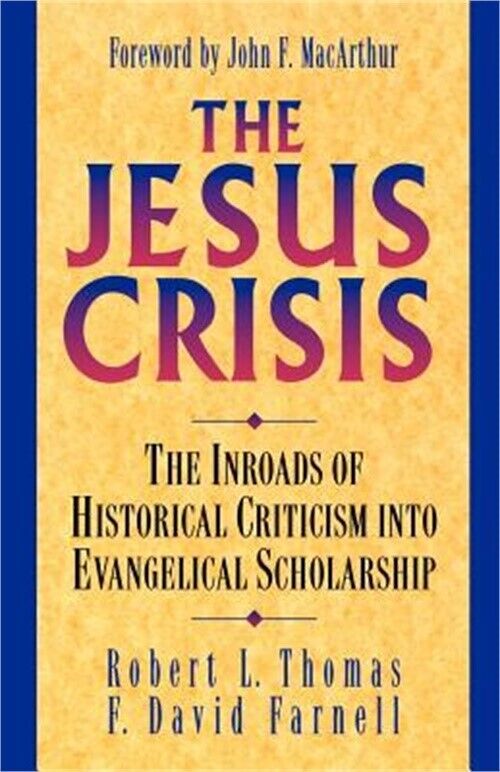
Figure 3: My least favorite book of biblical “scholarship,” The Jesus Crisis, which attempts to wage war on the historical-critical method.
For example, The Jesus Crisis is split up into two parts, Part 1: The Roots of Historical Criticism, and Part 2: The Fruits of Historical Criticism. Part 1 focuses on the presuppositions and historical origin of the historical-critical method, while part 2 argues that HC is bad for preaching, bad for hermeneutics, bad for apologetics, etc. I bought this book trying to investigate problems with HC to see if there were good criticisms of it, but I came away horrendously disappointed. Neither section is primarily devoted to engaging with the actual evidence and content of the method on its own terms. Where it does levy critiques of the method, it is usually presuppositional. It is good to challenge the presuppositions of a method, but not when such criticisms are question-begging or even inaccurate, as many evangelicals do appear to synthesize HC and evangelical faith.[5] There were some scattered references to the percent duplication between the Gospel authors and such, but not very much, as it was swiftly dismissed. There is a mountain of evidence that was not dealt with, as they were evidently not too concerned about that pesky stuff called “evidence”.[6]
The origins of historical critical methodology are in the Enlightenment,[7] but this is incredibly uninteresting for doing good biblical scholarship. Of course, Hume and others made arguments against miracles in historical method, but of interest to this discussion is not anti-supernaturalist argumentation, which is more of a distinction between theists and non-theists, but more about the historicity and sources of the Bible, which is an intra-Christian discussion point. Of particular interest here is the source critical development that came with Social Darwinism that the assumptions about how religion came to develop over time. This is a complicated topic, but Julius Wellhausen was one of the leading figures of this development in the late 1800s that proposed that the Torah had four sources that were edited over centuries and eventually compiled together after the exile in the 6th century BC, rather than the traditional narrative that says Moses wrote the Torah in the 15th century BC. This line of thinking is called the Documentary Hypothesis (DH). This conclusion came from faulty presuppositions about how religions and religious documents developed, and it was rooted in Social Darwinism. Identifying this historical backdrop is helpful and interesting, but that doesn’t give anyone a free pass to ignore the linguistic and related arguments for the DH. Those arguments stand on their own and have to be engaged with to do good scholarship. I do not think those linguistic arguments for the DH are very good either,[8] as they look a lot like literary gerrymandering, but they have to be refuted with argument and evidence rather than dismissal by presupposition.
The Synoptic Problem
In the same way, extensive literary, linguistic, and statistical analysis of the Synoptic Gospels indicate that there is literary dependence between Matthew, Mark, and Luke. The main argument is extensive places of almost or complete exact wording between the two Gospels in Greek (the language of writing). Arguments over the exact nature of this dependence have gone on for centuries, but Mark being first and Matthew and Luke using Mark as a source is a dominant view. In fact, this was dominant in the late 1800s, flipped for a while in early-mid 1900s from some famous publications, and became dominant again in late 1900s. The rejection of the historical-critical (HC) method for The Synoptic Problem attempts to connect the practice of source criticism to Enlightenment, anti-supernaturalism, and Social Darwinism. I find this, frankly, irrelevant for rejecting HC method. The other strand of argumentation employed is based on the early church fathers. It is true that the early church fathers unanimously attested that Matthew was the first Gospel written. It is these same church fathers that tell us that Mark was “Peter’s interpreter”, and that Luke was Paul’s travelling companion, and other statements of grave concern for the historical reliability for the Gospels. It is understandably a charged topic. However, someone made an interesting proposition, which I have adopted, that the slightly later church father’s reaffirmation of Matthean priority (the view that Matthew was written first) is actually based on an interpretation of Papias. Papias has might may just be the most difficult to interpret phrase of all time. It roughly translates as, “Matthew wrote his Gospel first, in the manner/language/dialect of the Hebrews.” An obvious question at first glance is – didn’t Matthew write his Gospel in Greek?? What does he mean by manner/language/dialect? Does it mean it mean Hebrew? Does it mean Aramaic (which was the “dialect” spoken by the ‘Hebrews’ which are the Jews)? Does it just mean it was written in their style? Does it mean it just has Semitisms? These questions have a potential role in understanding the historicity of this tradition, as there is consensus that Matthew was not initially written in Hebrew and then translated into Greek, as there is no evidence of translation, but there is evidence that it was written very well in literary Greek.[9]

Figure 4: Summary of what proportions of the Synoptic Gospels are unique to each, in agreement with one or the other (double tradition) or are shared among all three (triple tradition). Triple tradition is clearly a plurality of the synoptics, and a significant majority of Mark. (Source)
There’s no time for investigating the above further, but I accept that the church fathers were wrong on this point, that Mark was written first, and that later church fathers made this claim based mostly on Papias (and wrongly interpreted the language part of it, maybe). Geisler and crew do not find this acceptable because it could cast doubt on the historical reliability of the Gospels.
Anti-historical-critical scholars take it even further than just this and insist that the Gospel writers must be completely independent sources. This gets into historical method. Historians like having as many independent sources as possible. If Matthew and Luke use Mark as a source, then you might only have Mark and John as “independent” sources. Geisler and crew don’t like this. But he still doesn’t deal with the evidence. Additionally, there is apologetic value in accepting mainstream scholarship because you have additional possible sources. Scholars still accept that Matthew and Luke both had unique material and sources (considered M and L, respectively). Additionally, while much, much less of a consensus, there is an additional source called Q (for quelle, German for “source”) that is considered to inform Matthew and Luke. This leads to not 4 independent sources, but 5 (Mark, Q, M, L, and John). Additionally, historical critical scholars find pre-literary sources, oral traditions, that date back even before these.[10] Examples would include 1 Corinthians 15 creed, Romans 1:2-3, and the Christ hymn in Philippians 2. Another hotly debated one would be a pre-Markan passion narrative. So not only do they not deal with the evidence in the slightest, but they also miss out ways that could actually even more substantially support the truth of Scripture because of their presuppositions (which they often accuse others of having).
Conclusion
In short, I think evangelicals shoot themselves in the foot and corrupt their epistemology when they reject the historical-critical method. Instead, they should use it to carefully consider the truth claims of Scripture, its interpretation, and the historical, archaeological, and linguistic evidence and its bearing on Scripture. Frequently, the evidence illuminates Scripture, and Scripture can also illuminate the evidence. This was made clear to me when I audited a course on Biblical Archaeology; the path goes both ways. There is no need to see these things at war. There is certainly no need to decry the anti-supernaturalism of the Enlightenment when talking about logically independent arguments like the argument from literary dependence for Markan priority.
You cannot accept the possibility (or reality) of a historical method supporting a claim without accepting the possibility of that method opposing that claim. In fact, this is a simple point about the symmetry of evidence easily put in Bayesian terms. If some piece of evidence (E) supports a hypothesis (H), then the negation of that evidence (~E) supports the falsity of that hypothesis (~H) (aka is evidence against that hypothesis).[11] Michael Huemer has an excellent discussion of this point. Someone who uses source or form criticism to derive pre-biblical traditions to support historicity should allow for the possibility of source or form critical evidence to support non-traditional authorship or ahistoricity of biblical claims.
Accepting the historical-critical method does not automatically imply that one becomes a radical skeptic about Scriptural claims or even thinks there are any errors in Scripture. It merely allows for the possibility of errors that might be ascertained via historical inquiry. Of course, it may turn out to be the case that there are still no errors in Scripture, at least not derivable from historical inquiry. This is my current position – I accept inerrancy and the historical-critical method. The conclusions of that method on various questions I still find highly debatable, and the acceptance of the method also does not entail acceptance of all the most popular positions of historical-critical scholars, which include many revisionist positions.
I don’t really bother investigating the question of inerrancy anymore, as it is so peripheral to the core of my faith and I am skeptical of any good non-question-begging arguments in either direction,[12] and I think there are much more interesting and important questions that are more central to the core of the faith that I can investigate and contribute to, such as the existence of God, the resurrection of Christ, or Jesus as Messiah. I think evangelicals are much better off defending core Christian claims rather than making themselves look silly because they needlessly fight against the academy and the weight of good scholarship, both secular and evangelical.
[1] For example, Gerd Ludemann in his The Resurrection of Christ: A Historical Inquiry
[2] This has been discussed at length by scholars. A helpful guide and summary is found as an Appendix in Volume 2 of Raymond Brown’s The Death of the Messiah.
[3] See http://evangelicaltextualcriticism.blogspot.com/2019/04/pauline-authorship-according-to-british.html for a survey at a British NT conference. Now, this is a majority British conference, and British tend to have proportionally fewer evangelical scholars. Also see discussion in Raymond Brown’s An Introduction to the NT.
[4] I need to read Bart Ehrman’s Forgery and Counterforgery, for starters.
[5] This isn’t the place to engage with all the book’s arguments.
[6] It’s true, I’m being somewhat hypocritical because I haven’t actually demonstrated my claims in the slightest. However, consider this: trust me bro. Counterpoint: this is a blog post and I’m not pretending to do biblical scholarship, so it is likely not necessary to accomplish my goal, which is to share some of my thoughts on a topic.
[7] I don’t off the top of my head remember much about the history of 1700s historical critical scholarship. Kant and Hume and Spinoza and others made historical-critical arguments, I think source critical in nature. Which is fascinating to think about. In fact, even Porphyry in the first two centuries were make source critical claims about the OT and stuff.
[8] From my understanding, the supplementary hypothesis is much more prominent than the original documentary hypothesis in contemporary scholarship, or some other substantially modified version of it, but the point remains.
[9] Still koine Greek, which literally means “common” Greek, but a high quality nonetheless.
[10] I would guess they conveniently accept these, but I don’t know.
[11] Supporting evidence is frequently put in terms of the conditional probability P(H|E) > P(H), which says that the probability of some hypothesis given some evidence is greater than the prior probability of the hypothesis. However, this can only be true if P(H|~E) < P(H), which says that the negation of evidence E lowers the probability of the hypothesis. P(H|E) > P(H) if and only if P(H|~E) < P(H).
[12] I have a bit of epistemic conservatism going on – I think I came to the conclusion for what were good reasons, and, while I no longer think there is a good non-question-begging argument in either direction, I have not faced a defeater sufficiently powerful to make me gravely or even significantly doubt this belief. Thus, I believe I am justified in being an inerrantist.
 What the Gospel Demands

